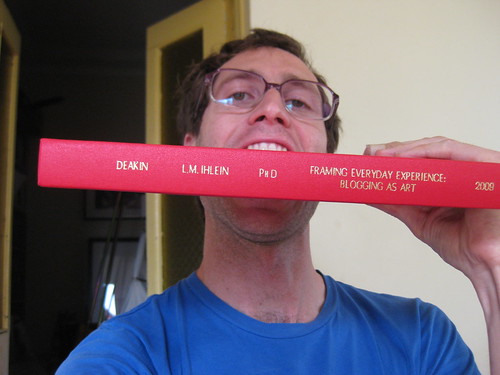
Between 2005 and 2009, I worked towards a PhD at Deakin University. It was a practice-based research project which involved the creation of two major projects, Bilateral Kellerberrin and Bilateral Petersham, and the writing of a 45000 word exegesis whose insights emerged from those projects.
In June 2011, I found out that the thesis won the Alfred Deakin Medal for Best Doctoral Thesis in the humanities and social sciences! You can read about the prize over here.
Here’s the reference to the thesis, on the Deakin University Library website.
If anyone would like to read it, email me and I’ll send you the pdf.
If anyone wants to publish it as a book, that would be nice! (It would go splendidly as a three-volume set with the book-blogs of Bilateral Kellerberrin and Bilateral Petersham.)
– – –
Here’s the contents page from the exegesis:
Introduction
-Blogging, Art, and Everyday Life
-Developing “Bilateral Blogging” as a Method of Artmaking
-Research Questions and Contributions
-Theory and Practice Informing the Research
-Research Methodology: Reflective Art Practice
-An Outline of the Chapters
-Relationship of the Practice to the Exegesis
Chapter One: Towards the Blog as Art
-Dialogue as an Aesthetic Practice: Peg#24
-Means and Ends in the Work of Robert Morris
-The Legacy of Allan Kaprow
-Experiential Frameworks: Kaprow’s Happenings
-Stories as Experiential Documents
Chapter Two: Relational Aesthetics and Bilateral Blogging
-Dewey’s Call for Reintegration
-Relational Aesthetics and Micro-Utopias
-Relational Aesthetics and the Illusion of Togetherness
-Bilateral Blogging in Kellerberrin
-Bridging Public and Private Spheres with Blogs
-A Bilateral Framework for Aesthetic Experience
Chapter Three: Framing Everyday Experience: Blogging and Attention
-Comparing Kellerberrin and Petersham
-An Economics of Attention
-Attention and Experience
-Attention and Aesthetic Experience
-Bilateral Blogging: Attention in Action
-Three Attention Frames for Generating Aesthetic Experience
–The Territorial Frame
–The Temporal Frame
–The Material/Technological Frame
-How the Attention Frames Work Together
Chapter Four: Transgression and Reintegration in Bilateral Petersham
-Exploring Bilateral Petersham’s Unruly Archive
-A Structural Anatomy of Bilateral Petersham
-Connecting with the Local in Bilateral Petersham
-Spatial Stories as Experiential Maps
-Transgression and Reintegration in Bilateral Petersham
-Blurred Borders: A Short Trip to Marrickville
Chapter Five: Online and Offline Blogging
-Offline Blogging
-Offline and Online Experience
-The Location of the Work of Art?
-An Inherently Variable Media: Blogging as Art, Art as Research
Conclusion
-Challenges and Opportunities of the Research Experience
-How the Research Questions were Addressed
-Contributions of the Thesis
–1. The Method of Bilateral Blogging
–2. The Production of an Experiential Map of Kellerberrin and Petersham
–3. An Attention Framework for Understanding How Bilateral Blogging Produces Aesthetic Experiences
-Possibilities for Future Work
–The Rise of Blogging as a Form of Art
–Beyond the Territorial Frame: Bon Scott Blog
–Documenting Ephemeral Art Practices
– – –
Below is the abstract at the start of the exegesis, which gives a brief outline as to what it’s all about (sorry if it sounds a bit pointy-headed). If you’d like to read it, write me an email and I’ll send you the PDF file.
In his 1934 book Art as Experience, John Dewey called for the reintegration of art with the processes of everyday life. According to Dewey, since the industrialisation of western society, art has become a compartmentalised sphere set apart from ordinary culture. This thesis asks, ‘what might the reintegration of art and life look like, in the early twenty-first century in Australia?’
Utilising a practice-based research approach, I have developed and refined a new method of art practice: “bilateral blogging” which works within the rhythms and spaces of everyday life. Inspired by the ‘blurring of art and life’ carried out by artists such as Allan Kaprow, the projects developed in this thesis – Bilateral Kellerberrin and Bilateral Petersham – extend twentieth century avant-garde art practice into the existing spaces of Australian neighbourhoods. This thesis shows how artworks like these, comprised of localised social relations, might also begin to document the specific interactive experiences which go into their own making.
I demonstrate that as a form of art practice, blogging can deepen engagement with everyday experience. It can produce a more dialogical relationship between artist and audience, and, importantly, it is able to generate rich documentation of situated experiences. Blogging is thus a research tool with the potential to bring to light aspects of everyday life which normally go unnoticed.
Through close reflection on the processes and outcomes of my own blog artworks, I have also developed a new way of identifying some of the aesthetic qualities of the experiences from which my relational art projects are made. Building on the work of William James, John Dewey and Allan Kaprow, I propose that attention plays a crucial role in transforming social interactions into aesthetic experience. The method of bilateral blogging developed in this thesis uses attention as a framing device, catalysing seemingly incoherent events into an intelligible, expansive structure.
This thesis thus makes three substantial contributions: a new method for making relational artworks; the production of an experiential document of the particular environments in which these artworks are situated; and a new approach to understanding the functioning of aesthetic experience. Taken together, these contributions bring a fresh perspective to discussions around the blurring of art and life, and the use of art as a mode of enquiry.
Many thanks to my thesis supervisor, Estelle Barrett, who is something of a creative Practice-Based Research maven…
Hello! Thank you for sharing your work! I’m a longtime blogger who thinks about journal blogging in terms of art, spirituality, and politics, and I would love to read your dissertation. Would you mind emailing me a copy? Thank you so much!
Katie
hi katie
i sent you the pdf – hope it’s useful
I’d be interested to know about your work with this area – fill me in! You may enjoy the writing of Richard Shusterman, a pragmatist philosopher who is also a practicing buddhist. I touch on his work very briefly in this exegesis but space contraints meant I couldn’t really go into his writing in more depth.
there are a few more blogging as art leads on this page:
https://lucazoid.com/bilateral/writing/
Hi Lucas,
As of second semester I will be a student at SCA so I am collecting the texts and tracts with which I hope to embed myself. Would like to obtain a copy of your thesis as there is much there I can absorb. Plan to spend more time in the Tending garden also.
Cheers,
Gilbert
Hi Gilbert – good to hear from you!
yep, check your email for the pdf
cheers
Lucas
Hi I would very much like to read your thesis. Could you email me so we can chat ? thanks.
Hi Lucas – firstly congratulations on your achievement. Well done you.
I’m working through my Masters in Visual arts and have been blogging my research and had hoped to use the blog as part of my final work but the Uni seems unable to make the jump into that format/idea. My work is not situational in a public way. It is under the working title of Valuing the Mundane and is currently a three-pronged diaristic practice using textile media and blog, centered on my own domestic mundane. I would very much appreciate seeing your writing. Finding this work of yours has made my day. Cheers
Viv Davy
hi Viv
I’ve replied via email…
although the blogs were the core of my creative research, i printed them out as blog-books and handed these physical forms to the examiners, and the thesis was conventional in an academic way, referring extensively to the blog but not asking the examiners to consider the blog to be a replacement for the academic submission.